State Building and the Security Sector
Research Overview
My research on state building and the security sector asks the following questions:
What are the effects of different (internationally-led) security sector reforms among locals?
What are the effects of different (internationally-led) security sector reforms on the cohesion of personnel?
Under what conditions do people’s perceptions of the security sector change?
Under what conditions do international actors engage in security sector/police assistance?
Research Methods: Field Experiments, Lab-in-the-field experiments, large-scale surveys, cross-national data collection, and interviews mostly all in Liberia
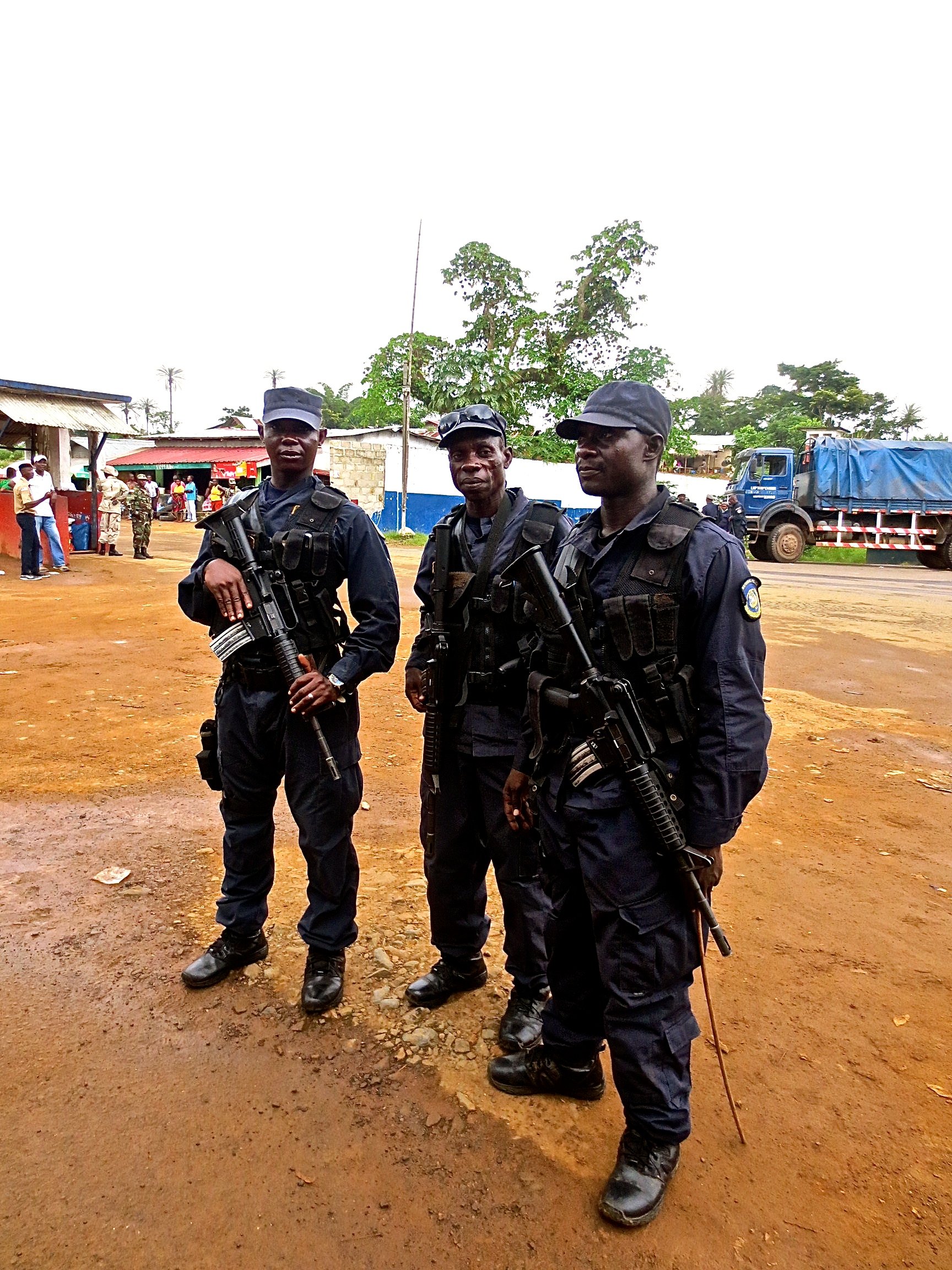
The research finds that international actors play an important role in helping to implement certain security sector reforms such as ethnic balancing, gender reforms, and the creation of new operational units. The US is more likely to help implement security sector reforms that focus on building operational capacity, whereas the UN is focused more on governance-oriented reforms such as diversity reforms (e.g. female ratio balancing and ethnic balancing). In Liberia, female ratio balancing reforms helped police unit cohesion and sometimes helped improve the perception of the security forces. They did not necessarily increase awareness about sexual and gender based violence among police officers nor improve perceptions of the police during household visits when compared to visits by male officers. Ethnic balancing reforms in Liberia did not dampen cooperation among personnel, but we found that minority police officers were more discriminatory towards their own minority ethnic group, perhaps as a way to fit into the police organization. When it comes to improving the perception of the police, household visits by regular male and female police officers rather than community patrol by operational units improved perceptions. Male and female police officers’ visits were equally likely to enhance the public’s perceptions of the police in rural Liberia. Community patrol by operational units decreased some forms of crime in communities. Other factors that affect perceptions of the security sector include crime victimization, which increased demand for the police; securitization policies, which improved perceptions of the military, but not the police; and successful electoral transitions, which improved police and civilian perceptions towards each other.
Peer-Reviewed Published Research
-
Under what conditions does state expansion into limited statehood areas improve perceptions of state authority? Although previous work emphasizes identity or institutional sources of state legitimacy, I argue that relationships between state agents and citizens drive positive attitude formation, because these relationships provide information and facilitate social bonds. Moreover, when state agents and citizens share demographic characteristics, perceptional effects may improve. Finally, citizens finding procedural interactions between state agents and citizens unfair may adopt negative views about the state. I test these three propositions by randomizing household visits by male or female police officers in rural Liberia. These visits facilitated relationship building, leading to improved perceptions of police; shared demographic characteristics between police and citizens did not strengthen this effect. Perceptions of unfairness in the randomization led to negative opinions about police. The results imply that relationship building between state agents and citizens is an important part of state building.
-
In the aftermath of civil conflict, war-torn states often require reform of their government institutions. Gender balancing, or the inclusion of more women in security-sector institutions, is an increasingly common reform incorporated into state-building processes. Our theoretical priors suggest that gender balancing may influence unit cohesion, operational effectiveness with respect to sexual and gender-based violence, and organizational gender norms. We study these propositions using laboratory experiments with police officers of the Liberian National Police (LNP). We randomly assigned the proportions of women and men in 102 groups of six LNP officers to observe their deliberative processes and group choices. In our experiment, adding more women increased unit cohesion, but we find no evidence to suggest that simply adding more women would increase group (or individual) sensitivity to sexual and gender-based violence. We also find that, despite an increase in participation and influence by women, male beliefs about women's role in policing do not improve with the inclusion of women. As one of the first experimental studies to assess the effects of gender composition within the actual population of interest, our results shed light on how international interventions to address gender equality in postconflict countries affect important outcomes related to security.
-
Civilian confidence in domestic institutions, particularly in the security sector, is important for stability and state consolidation in post-conflict countries, where third-party peacekeepers have helped maintain peace and security after a conflict. While other scholars have suggested that a strong security sector is necessary for mitigating the credible commitment problem, this article provides two alternative criteria for assessing security sector reforms’ effect on confidence in the security sector: restraint and inclusiveness. Female ratio balancing in the security sector meets these two criteria, suggesting that it has the potential to help enhance confidence in the security sector and thereby create the right conditions for the peacekeeping transition. The argument is tested using original surveys conducted in post-conflict, ex-combatant communities in Liberia. The expectations received empirical support. The findings indicate that restraining and inclusive reforms could improve trust in the state’s security sector. They also demonstrate the importance of considering gender in theories related to post-conflict peace building and international relations more broadly.
-
How to restore citizens’ trust and cooperation with the police in the wake of civil war? We report results from an experimental evaluation of the Liberian National Police’s (LNP) “Confidence Patrols” program, which deployed teams of newly retrained, better-equipped police officers on recurring patrols to rural communities across three Liberian counties over a period of 14 months. We find that the program increased knowledge of the police and Liberian law, enhanced security of property rights, and reduced the incidence of some types of crime, notably simple assault and domestic violence. The program did not, however, improve trust in the police, courts, or government more generally. We also observe higher rates of crime reporting in treatment communities, concentrated almost entirely among those who were disadvantaged under prevailing customary mechanisms of dispute resolution. We consider implications of these findings for post-conflict policing in Liberia and weak and war-torn states more generally.
-
Peace agreements often include provisions for integrating minority ethnic groups into security sector institutions. Advocates argue that “ethnic balancing” reduces discrimination; opponents counter that it erodes unit cohesion. We test these predictions against each other using surveys and lab-in-the-field experiments implemented with teams of Liberian National Police officers. We find that teams that include minority police officers are no more or less cooperative than those that do not, and that heterogeneous teams are no more or less cooperative than homogeneous ones. We also find, however, that teams with minority police officers are more rather than less discriminatory against minority civilians—a substantively large and highly statistically significant adverse effect. We show that this effect is not driven by heterogeneity, but rather by the presence of minority police officers per se. We explore potential mechanisms and provide reasons for both optimism and caution towards ethnic balancing in deeply divided societies.
-
The US and UN are two of the largest patrons of police reform programs worldwide: between 2000 and 2020, the US provided approximately $160 billion in police assistance to more than 130 countries worldwide; simultaneously, the UN spent over $77 billion supplying police-oriented security sector reform to countries experiencing or having experienced armed conflict, doing so through the deployment of peacekeeping missions and within the offices of UN Police, the UN’s hub for police reform and training programs. Though these two providers seek the same overall objective, they often vary in their specific goals: the US often engages in foreign police reform to promote its own national security objectives which means increasing institutional capacity, while the UN adopts police reform programs to promote institutional constraint. The two models have important implications for how we understand bilateral and multilateral reform programs, including activities performed and recipient countries targeted across both time and space. Using originally collected data on US security assistance programs as well as a careful analysis of original data on UN mandates, this article provides the first quantitative exploration of these two different modes of assistance, comparing and contrasting their objectives and where, when, and how they are provided.
-
With the passing of several UN Security Council Resolutions related to Women, Peace and Security, gender balancing security sector reforms (SSR)—or policies that ensure the equal participation of women in the security sector—have received increased global attention over the past two decades. However, to date, there is no explanation for variation in their adoption. This paper examines the internationalization of SSR gender reform, arguing that the presence of a peacekeeping mission within a post-conflict country affects the state’s resources and political will to adopt gender balancing reforms. We explore the effect of multidimensional peacekeeping using an original dataset on SSR in post-conflict countries, the Security Sector Reform Dataset, from 1989 to 2012. We find that peacekeeping missions increase the probability that a state will adopt gender balancing reforms in SSR. As the first cross-national quantitative examination of gender balancing reforms, these findings also shed light on the conditions under which states adopt security sector reforms more generally.
-
Item description
-
During highly uncertain, post-conflict elections, police officers and youth-wing party activists often engage in low-intensity electoral violence, which cannot be readily explained by national-level, institutional, and elite-level strategic incentives for violence. Responding to calls to examine “non-strategic” election violence, this article examines both the key actors most likely to perpetrate violence on-the-ground, and the micro-level perceptions underlying their decisions. In post-conflict contexts, police and youth wing party activists operate within uncertain, information-poor, and weakly institutionalized settings. Consequently, their preexisting attitudes towards the use of violence, democracy, electoral institutions and towards other political actors influence how and when they engage in electoral violence. We propose two different paths for reducing this uncertainty and improving attitudes: a) civic engagement programs and b) experience with “crucial” elections, which we define as the first post-conflict election following the withdrawal of external guarantors of electoral security. We employ a unique, locally-led field experiment and panel data collected during the 2017 Liberian election to demonstrate how a``crucial election'' improved attitudes of both police and youth activists, while civic engagement programming did not. These findings suggest that elections following major structural reforms may reinforce democratization by improving the attitudes of the actors most likely to participate in violence.
Work in Progress
-
What effect do election violence prevention programs have on the attitudes of police and youth party activists? Due to their frontline roles in the management and governance of elections, police officers and youth party activists are central to the violent breakdown of elections. Particularly in post-conflict democracies, this violence arises within contexts of high uncertainty and low information. Often with minimal oversight and following conflicting directives, police and youth must make immediate decisions about how to respond to electoral challenges, be these at polling stations or mass protests. These choices are made in part based on misinformation and mistrust regarding electoral institutions, democracy, the appropriate use of violence, and the roles of other street-level actors. In this context, without improved information and attitudes, it is difficult to overcome deep seated mistrust and to adapt to challenges in peaceful rather than destructive ways. Recognizing this, election violence prevention programs aimed at attitude change have become increasingly popular, but they do not target the actors most likely to participate in violence. Through a unique partnership with the Liberian National Police, we randomly selected 120 police and 300 youth party activists to participate in a locally-designed and led violence prevention program set during the 2017 presidential election. While the intervention did not alter attitudes, the results suggest successful ``milestone" elections can improve police and youth attitudes towards democracy, violence, formal institutions, and towards one another.
-
Epidemics that overwhelm health and national institutions tend to disproportionately affect individuals from marginalized communities. The securitization of epidemics further exacerbates feelings of alienation and victimization by security forces among those in marginalized communities. Our study focuses on how securitization affects views in marginalized communities in post-conflict countries providing some proof of concept that pandemics and security responses could negatively impact perceptions of marginalized populations about security forces. We use the 2014 Ebola Virus Disease epidemic in Liberia as a case study to explore how the securitization of a health crisis affected marginalized communities. We leverage two, unique surveys conducted before and after the Ebola Virus Disease epidemic in two of Monrovia’s informal communities with histories of internally displaced persons and ex-combatants in Monrovia, Liberia---West Point and Peace Island. Our analysis allows us to assess differences in public opinion before and after the Ebola Virus Disease. We find that perceptions of police discrimination and disrespect increased in both communities and that demand for police services declined in both communities. With respect to the Armed Forces, direct contact with soldiers enhanced feelings of safety, but only among those who did not witness them engaging in abuse. Our findings suggest that securitization epidemics could exacerbate trust in the state, thereby weakening its legitimacy.
-
International statebuilding targets weak, post-conflict countries, yet little is known about the actual civilian preferences for the type of international statebuilder, the degree to which international statebuilders should be involved in statebuilding, and the types of institutions they should rebuild or reform. This is concerning, for civilians are central to successful post-conflict statebuilding and peacebuilding processes. We develop a theory of civilian preferences for international statebuilding, arguing that civilian distrust in the state government leads to preferences for multilateral or democratic statebuilders over non-democratic statebuilders and for these statebuilders to engage actively in rebuilding--not just passively monitoring reform--of the state security forces over other bureaucratic institutions. We test these hypotheses on original surveys using three sets of conjoint experiments embedded in Liberia and Haiti. Generally in line with our expectations, our results from Monrovia, Liberia, show that civilians prefer international, to domestic, statebuilders, with a particular preference for multilateral and democratic international statebuilders; we also find that civilians prefer security-oriented statebuilding reforms over non-security-oriented statebuilding reforms. Better understanding such nuances of internationally-backed statebuilding reform is important for ensuring the legitimacy of post-conflict state institutions.